Showing posts with label red cedar. Show all posts

Wednesday, August 6, 2014

Ode to a Red Cedar

We're now packing up our last boxes and getting ready to say goodbye to the apartment where we've lived for the past four years. There have been some cool things about this place (my garden comes to mind), but there's only one thing that I've really loved about it, something I don't think I'll ever quite be able to duplicate, and that's the two Red Cedar trees outside the windows. These trees have been the stage for many of my blog posts over the years because -- even sandwiched as they are between two houses -- they attract an amazing variety of creatures, giving us close-up (just feet away) eye-level views of visiting and resident birds (and more!) in every season. Seeing and identifying Yellow-rumped Warblers in these trees in our first year here was one of the things that got me really paying attention to and learning more about birds.

I'm going to miss living next to these trees very much. So to try to remember what it's been like to live here for the past few years, here's a compilation of all the posts I've made featuring these trees and the creatures they've brought to our windows, season by season. (Plus one new sighting that I haven't had a chance to post about yet.) This isn't everything we've seen here, of course, just everything that's stuck around long enough for me to photograph it. Dear Red Cedar trees, thank you for everything, and I only hope future human residents appreciate you as much as we have!

In spring:
 

In summer: 

  • During occasional (or, in recent years, more than occasional) heat waves, panting House Sparrows (Jul 2011) and Black-capped Chickadees (Sep 2012) hang out in these branches trying to keep cool.
  • Titmice bathe and forage here as well (Aug 2012).
  • This summer, these trees have become a daily relaxing parlor for a couple of Gray Squirrels. Usually, these squirrels doze on separate branches, but a few days ago, they settled onto the same branch for a grooming session:

Fall is a huge time for these trees:
A Cape May Warbler in September 2013

A feasting Yellow-Rumped Warbler in October 2013


    In winter:


    And the year starts over again with spring. Red Cedar trees, you are the best, and I hope you will continue to enliven this place for many years to come!

    Thursday, October 4, 2012

    Cedar Waxwings Galore

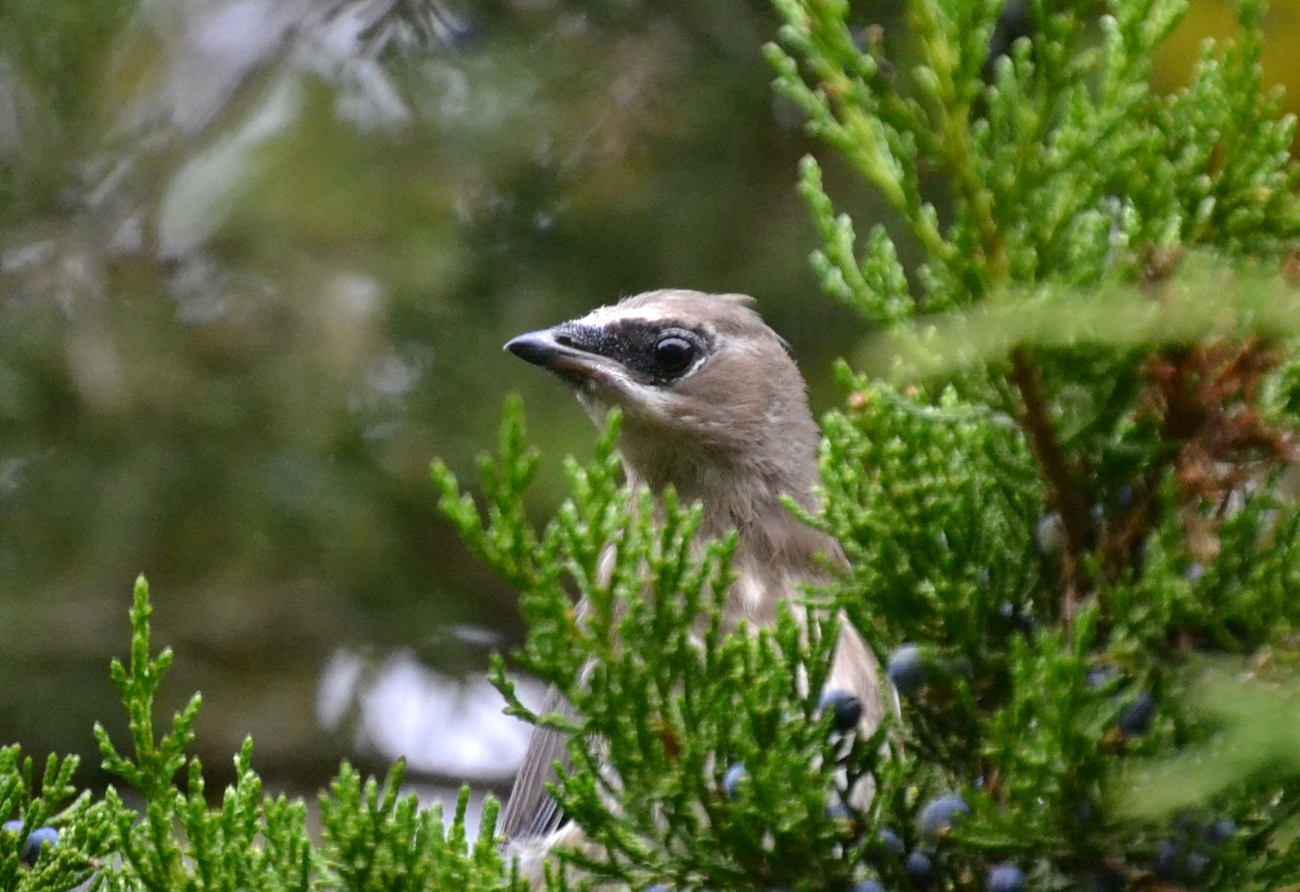
    The Red Cedar tree in our yard is now officially open for business, so say the Cedar Waxwings who were busy feasting on its berry-like cones all day today:
     
    A waxwing in a sea of food.
    I counted about 20 or so Cedar Waxwings in this flock, but there could've easily been more -- they were moving around so much, it was hard to get an idea of how many were actually out there. Most of the birds were juveniles, with streaky breasts and a generally scruffy appearance:
     

    Hello scruffy bird, see anything you like?
     

    In fact, I only saw one individual with the sleeker feathers and those funky red waxy deposits on its wing tips that mark older birds:
     

    So this may not have been the fanciest group of waxwings ever, but these birds were a ton of fun to watch as they scarfed down as many cones as they could, as quickly as possible. And yeah, the juveniles could actually be pretty sleek, too:
     

    Look, a waxwing tongue!
     

    Speaking of tongues, there were a few other birds sampling Red Cedar cones today as well, including, to my surprise, a Northern Flicker -- I didn't think these birds ate fruit, but I guess they do! A few cones down, and then it licked its lips....
     

    Now that's a tongue!!

    I'll keep an eye on this tree to see what other creatures stop by for a snack. Hopefully there will be enough food to go around for a while yet!

    Tuesday, October 2, 2012

    Invading Red-breasted Nuthatches, and More Birds Passing Through

    As I mentioned in an earlier post, Connecticut (and the rest of the United States, actually) is current experiencing an irruption of Red-breasted Nuthatches. This means there are now way more of these little birds scampering around than usual, and so I've been thinking that it should be only a matter of time before a Red-breasted Nuthatch shows up in our yard. I was quite happy this morning, then, when the Red Cedar outside our apartment's windows played host to one of these unusual visitors!


    You are so cute, little bird, and so good at being upside-down. I love those fluffy, rusty feathers under your belly!


    I was struck, actually, by how similar this bird's costume looked to those of the Black-capped Chickadees who were also flitting through the trees. Shift around the black and white on your face, little nuthatch, stop climbing along the undersides of branches, and you're practically a chickadee. (Well, almost.) The chickadees were making the comparison even easier this morning by carrying around big black sunflower seeds, so their beaks looked almost nuthatch-length (although way too bulky):
     

    Chickadee... Red-breasted Nuthatch... It's like they were shopping in the same clothing store:


    OK, one last chickadee picture, because these guys were being especially photogenic this morning, and I couldn't help myself:


    So the Red-breasted Nuthatch was exciting. Around the same time, a tiny Ruby-crowned Kinglet passed through these trees as well -- this is another very cool bird who only rarely stops by, and usually only in the spring and fall:
     

    As you may have noticed in some of these pictures, the Red Cedar's fleshy cones -- which are like dark blue berries -- are now ripe and ready for birds to scarf them down. Over the past couple of days, a small flock of Cedar Waxwings has been visiting our tree, but so far these birds have been plucking berries from the far side of its branches, and (mostly) hiding from my camera:


    Hey birds, there are tons of good berries on this side of the tree, too! The buffet's open, so come on over!

    Saturday, May 5, 2012

    Many Bright Creatures in Two Gray Days, Part 2: Birds and Flowers

    There were tons of birds out and about on Thursday and Friday morning when I visited the meadows of Naugatuck State Forest, including some very colorful newly-arrived migrants that stayed active the whole time I was there. These sorts of wet, overcast days seem to be just about perfect, it turns out, for seeing awesome creatures (a fact I will need to remember for the future), and I found only one real downside: My camera has a very hard time focusing on quick-moving birds in low-light conditions. Nevertheless I managed to capture a few pictures of these flying gems as they flitted among the bushes and trees around me.

    A bunch of Yellow Warblers made a strong presence, announcing themselves with their loud cheerful songs:


    Several Blue-winged Warblers were hanging around, too, singing their little songs that sound like a wheezy breath in and out (which, since I read that description in my Peterson field guide, is the only thing I can think of now when I hear these birds):


    Sing it, little bird!


    A single male Chestnut-sided Warbler graced me with his presence, and even came quite close:


    I honestly think this is one of our prettiest birds. He has so many colors, and such an interesting costume! Even from the back, he's a striking little creature:


    There were Ovenbirds singing all around, but I only saw one individual who popped up into view for a few seconds before flying off again:


    Also hanging out (though not within camera-range) was a male Scarlet Tanager, some Black-throated Green Warblers, a Black-and-white Warbler, a Blue-headed Vireo, and probably many other species that I didn't see or identify. I love the huge variety of cool birds that are showing up now!

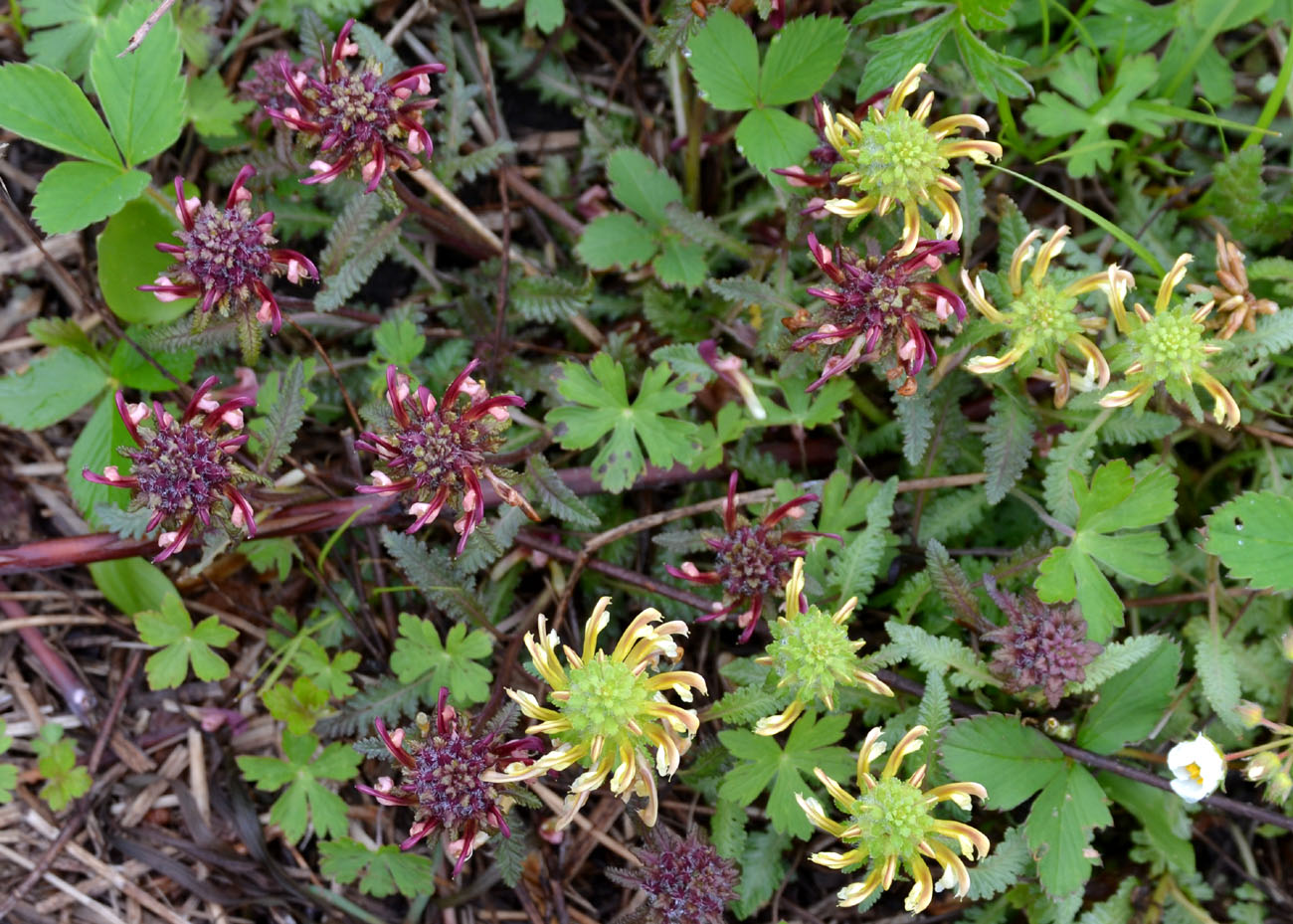
    The weather also made for some lovely wildflower sights -- colorful blooms were practically luminescent against the damp ground. Here's another, better view of the Wood Betony that I found the other day, with its gorgeous yellow and/or red whorls of blossoms:


    I'm definitely impressed by the range of possible colors on these plants:


    This lovely little Starflower (Trientalis borealis) shone out from under the trees:


    Huh, a flower with seven petals (normal for the species).... How strange, and yet beautifully symmetrical!

    I was very happy to see these Wild Red Columbines in bloom -- they're one of my favorites, and I don't find them very often:


    And I can't believe how utterly gorgeous these Pink Azalea (Rhododendron periclymenoides) blooms were, like something straight out of a fairy tale:


    Finally, not to be outdone by the flowers, the masses of cedar-apple rust galls on the Red Cedar trees were pretty phenomenal -- and I thought the handful of orange-tentacled galls on the trees outside our apartment windows were impressive!


    After two days of exploring the woods in what I thought would be less than ideal conditions, I have definitely come to appreciate the benefits of soggy weather. Here's to active birds, reptiles, and amphibians, blooming plants, and lots of color on deceptively gray days!

    Sunday, April 22, 2012

    Red Cedar Alien

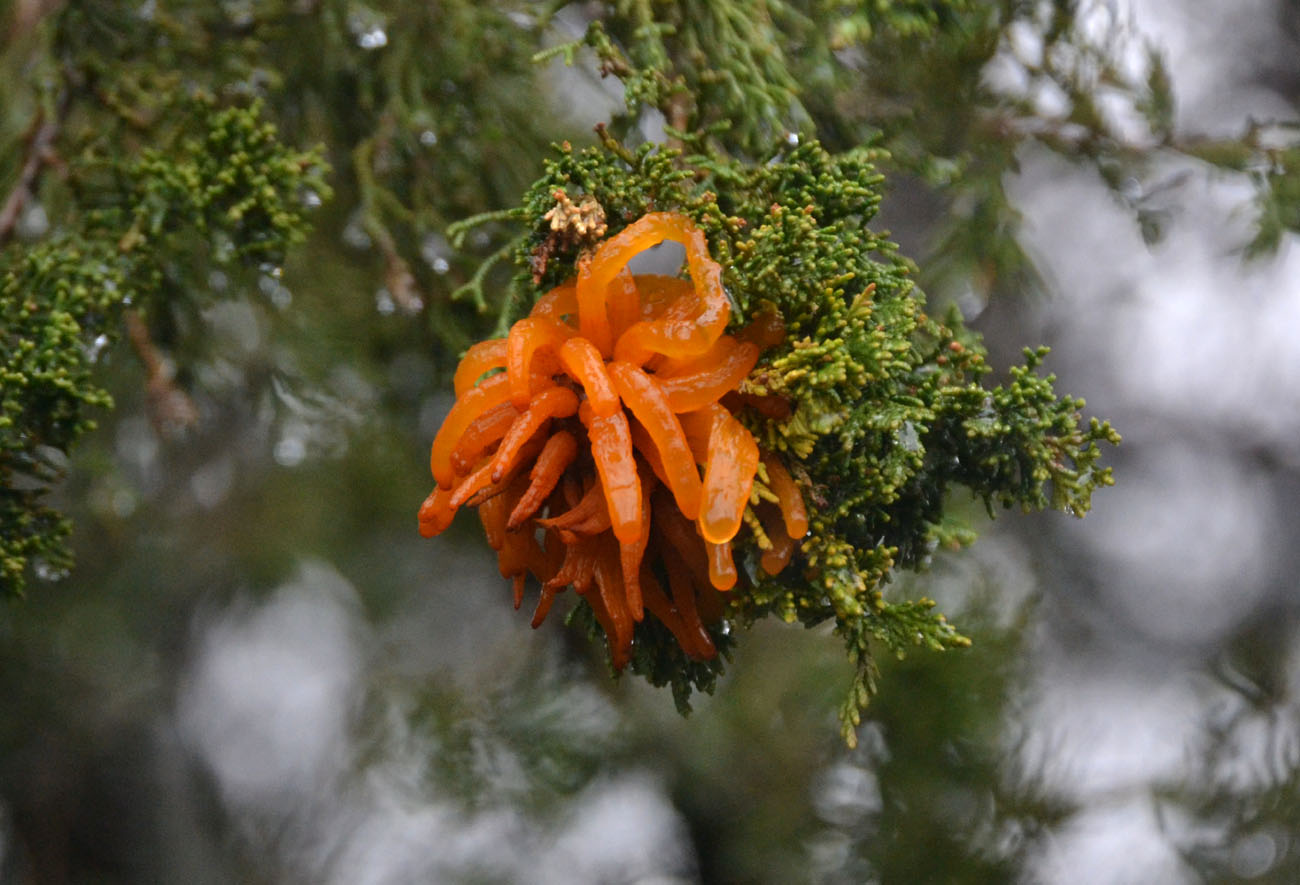
    The two Red Cedar trees next to our house not only serve to draw in birds passing through our yard, they also play host (literally) to some very interesting organisms. This morning, I looked out our office window and saw this:

    Ahhh, it's an alien! Well, no, not really. It's actually a gall, caused by the fungus Gymnosporangium juniperi-virginianae. Galls appear when an insect or fungus feeds off of a plant and somehow changes the plant's structure, causing it to produce abnormal growths, inside of which the insect or fungus then lives. (For the tree, then, I guess this might actually count as an alien invasion.) Each gall-making creature has its own preferred host plant, and each causes a distinctive abnormal growth.

    During the winter, these galls on our Red Cedar trees just looked like brownish balls -- they could have been windblown pinecones at first glance -- and it wasn't until recently that they sprouted these weird orange tentacles. (I only noticed them today.)

    Those "tentacles" are actually the spore-producing appendages of the fungus inside the gall. According to this fascinating information sheet on cedar-apple rust (the "disease" caused by this fungus, so-called because the fungus actually needs to live on both cedar trees and apple trees in different stages of its life cycle), the tentacles (i.e., "telial horns") enlarge during periods of rainy weather, and indeed, with today's constant rain, the fungus was looking spectacularly goopy by the end of the day. (The gall in this next picture is the same one from the previous picture, but several hours later.)


    I can see five of these galls from our window, and who knows how many more there are higher up in the trees. The fungus won't do lasting harm to the Red Cedars (these orange appendages mark the end of their life cycle), so our trees should be around for a while yet. Who knows what strange and interesting things these trees will show us next!

    Monday, October 24, 2011

    A Red Cedar Celebration

    I don't think I'm exaggerating when I say that my absolute favorite thing about our apartment is the view from my office window. And it's not a view of open sky and steep hills, either -- that's what you see when you look out our other windows -- it's a view directly into a tree that stands a few feet from the window and exactly at eye level, a tree that just happens to be a Red Cedar (also called a Red Juniper, Juniperus virginiana).

    This tree is magical. Its dense, scaly, evergreen leaves provide shelter for any creature who needs it, and because it's so near our window, that means we get to see some cool animals up close. (This tree has been featured in the background of some of my posts already, in its capacity as a perch for baby Tufted Titmice, hot House Sparrows, and other assorted creatures.) And in the fall (i.e. right about now), it produces a bonus treat: juicy flesh-covered cones that look like small blue berries, and which the animals -- especially the birds -- just love.


    The female Northern Cardinal in the picture above was snacking on the Red Cedar's offering this morning, mashing up the cones' pulp in her big beak, and getting not a little messy in the process (pretty girl, wash your face!):


    Last week, a few American Robins stopped by for a meal -- a sleek adult:


    And a gangly juvenile or two:


    I even saw one of our local Gray Squirrels munching on the cones a couple of days ago -- our squirrels seem to prefer maple seeds, but perhaps the Red Cedar adds some nice variety to their diet:


    Last year, this tree produced a bumper crop, with little blue spheres clustered on every branch tip, and we got long visits from very happy flocks of Cedar Waxwings and Yellow-rumped Warblers as a result. This years bounty is much more tame, but still, the cones are just sitting there waiting to be eaten, and I'll be watching to see which animals stop by to oblige!

    To the person who decided, long ago, to plant this tree outside our window: Thank you!


    **Blooper Reel**

    At one point in my photo shoot with the female Northern Cardinal, she shook her head, and I snapped a picture at just exactly the wrong moment. Here's the semi-disturbing result:


    She's fine, I promise!